"When you have lived as long as I, you will see that every human being has his shell, and that you must take the shell into account. By the shell I mean the whole envelope of circumstances. There is no such thing as an isolated man or woman; we are each of us made up of a cluster of appurtenances. What do you call one's self? Where does it begin? Where does it end? It overflows into everything that belongs to us—and then flows back again. One's self—for other people—is one's expression of one's self; and one's house, one's clothes, the books one reads, the company one keeps - these things are all expressive."

— Henry James (via whiskey river)

-

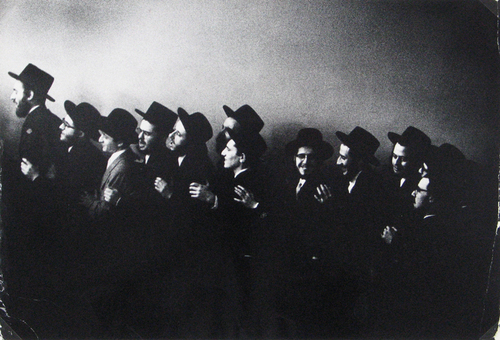
Leonard Freed, Wedding Dance, Williamsburg, New York, 1954 (via MoMA)

-

"So it follows that all that is here is not to be despised and put down, but, precisely because it did precede us, to be taken by us with the innermost understanding that these appearances and things must be seen and transformed."

— Rainer Maria Rilke, from a letter to Witold Hulewicz, 13 November 1925 (via)

"So the photographs are the punctuation points in my work process. But I do see them as dysfunctional narratives. They look like they’re beginning to tell a story; you try to make associations between the people and what they’re doing but you can’t necessarily find a narrative... I want you, the viewer, to be following a natural progression, a natural course of events. By having the camera as a witness—I’m not tampering."

— from an interview with Sam Taylor-Wood in BOMB

-

Next month, New Directions will publish a collection of William Carlos Williams’s translations of Spanish and Latin American Poets.  By Word of Mouth: Poems from the Spanish 1916–1959 has been compiled and edited by translator and Williams’ scholar Jonathan Cohen. Included in this bilingual edition are the giants—Neruda, Paz, and Parra—as well as many lesser-known poets such as Alfonso Guillén Zelaya and Alí Chumacero. (via)

-

"In space
                I am
inside of me
                    the space
outside of me
                       the space
nowhere
               I am
outside of me
                      in space
inside
           is space
outside of it
                    nowhere
I am
         in space
etcetera"

— Octavio Paz, "Reversible" in The Collected Poems
-

Harry Callahan, At the Water's Edge, 1972, Cape Cod (via)

-

"I'm beginning to know myself. I don't exist.
I'm the space between what I'd like to be and what others made of me.
Or half that space, because there's life there too...
So that's what I finally am...
Turn off the light, close the door, stop shuffling your slippers out there in the hall.
Just let me be at ease and all by myself in my room.
It's a cheap world."

— Fernando Pessoa, "[I'm beginning to know myself]" in Poems, trans. Edwin Honig and Susan M. Brown


"You have to remember this isn't your land.
It belongs to no one, like the sea you once lived beside
and thought was yours. Remember the small boats
that bobbed out as the waves rode in, and the men
who carved a living from it only to find themselves
carved down to nothing. Now you say this is home,
so go ahead, worship the mountains as they dissolve in dust,
wait on the wind, catch a scent of salt, call it our life."

— Philip Levine, from "Our Valley"

-

"As for Keats, I think he inherited an aesthetic that only allowed him to write about lovely things. Whereas Lorca inherited an aesthetic that allowed him to write about anything—even what he didn't understand. And that was one of the wonderful things that I got from him, and later got from Pablo Neruda—the idea that you could go after these very powerful centers of feeling in you, even if you couldn't parse them."

— Philip Levine, from a 1999 interview in The Atlantic

"I want to know the root goes deep
on all that came before,
you could lay a soaker hose across
your whole life and know
there was something
under layers of packed summer earth
and dry blown grass
to moisten."

— Naomi Shihab Nye, from "Last August Hours Before the Year 2000"

-

Egon Schiele, Street in Krumau, 1917

-

"Women and couples in Klimt's erotic drawings swim in their own sexuality and at the same time swim away from themselves in line and contour. They unveil their sensuousness. Schiele's erotic figures don't unveil, they expose themselves, angular and strung-out, like guilty things caught. Certain poems unveil themselves with an almost ceremonial patterning, while others are spiky and nervous, as if words were rudely taken hostage to feeling. Plath's are like that, and many of Williams's early poems. Then there are poems, the precious few, that seem long-prepared, arranged just so, with a deliberate rhetoric, but nothing in them feels inauthentic or worked up for the sake of writing a poem. Then there are others, the proliferating many, prepped and constructed for quick and easy consumption. Of these we remember none of the words, nothing of the noise or music, only the scene, or anecdote, or 'voice.'"

— W. S. Di Piero, from "Semba!: A Notebook"

-

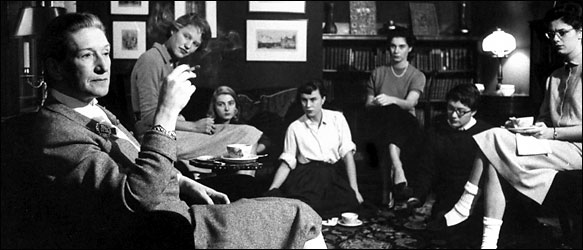
Elizabeth Bowen with students at Bryn Mawr, 1956. Photographed by Alfred Eisenstaedt

"If Bowen is not read now as widely as Henry James and Virginia Woolf, to whom she is often compared, it may be not because of her hyphen (since the specific concerns of the Anglo-Irish are not so widely understood these days), or the intricacy of her style. It may be, instead, that it is difficult to read a writer who bears down so hard on intimacy—among not only men and women, but men and women and their country, their houses, their pasts and themselves—and with an overwhelming, Irish sense of a bottomless, ancient pool of loss. She is as ruthless as James, as stylistically uncanny as Woolf, but with an ineradicable sense that history is made of other people's dirt. In photos, Bowen is impeccably ladylike, with a long upper-class face. But in her work, she's not reserved and her concerns do not seem quaint; she ventures unbearably close to ruins and wreckage, offering as consolation only an aesthetics of the haunted."

— Stacey D'Erasmo, from "Elizabeth Bowen: A Fan's Notes"

"'There’s a strange thing about love,' said Sophia. 'The more you love someone the less that person likes you.' 'That’s very true,' commented the grandmother. "And then what do you do?' 'You keep loving,' answered Sophia threateningly. ‘You love more and more terribly.'"

— Tove Jansson, The Summer Book (via NYRB)

-

Pablo Valbuena, part of his Augmented Space project (see more here)

-

"I don't love you as if you were a rose of salt, topaz,
or an arrow of carnations that propagate fire:
I love you as one loves certain dark things,
secretly, between the shadow and the soul.

I love you as the plant that doesn't bloom and carries
the light of those flowers, hidden, within itself,
and thanks to your love the tight aroma that rose
from the earth lives in my body in darkness.

I love you without knowing how, or when, or from where
I love you directly without problems or pride:
I love you like this because I don't know any other way to love

except in this form in which I am not nor are you,
so close that your hand upon my chest is mine,
so close that your eyes close with my dreams."

— Pablo Neruda, "Sonnett XVII" in The Poetry of Pablo Neruda, trans. Mark Eisner

-

"Tichý the man was equally disheveled. A ragged town eccentric, he had been trained as a classical painter but quit the academy after the Communist takeover forced artists to focus on socialist subjects. He remained, however, a diligent practitioner of the arts. He took three rolls of film a day, printed each negative only once, and embellished the prints with homemade frames. The results amount to a clever commentary on the state; his disguised cameras and the atmosphere of surveillance in his work subtly allude to the surveillance of the society at large. But the furtive pictures are also beautiful. They recall the scratched bodies of Degas’s bathers; they presage the soft focus of Richter. Their imperfection imprints them with the personal. As Tichý himself said, 'A mistake. That’s what makes the poetry.'"

-- from The Paris Review's portfolio and profile of Miroslav Tichý's work

-

Miroslav Tichý

-

"That's the way it goes. For many weeks you have been exploring what seemed to be a profitable way of doing. You discovered that there was a fork in the road, so first you followed what seemed to be the less promising, or at any rate the more obvious, of the two branches until you felt that you had a good idea of where it led. Then you returned to investigate the more tangled way, and for a time its intricacies seemed to promise a more complex and therefore a more practical goal for you, one that could be picked up in any number of ways so that all its faces or applications could be thoroughly scrutinized. And in so doing you began to realize that the two branches were joined together again, farther ahead; that this place of joining was indeed the end, and that it was the very place you set out from, whose intolerable mixture of reality and fantasy had started you on the road which has now come full circle. It has been an absorbing puzzle."

— John Ashbery, from Three Poems (via The Muse Daily)

-

"I have the feeling that his hands ache, that he is tender
and absorbed in thoughts, he licks everything before killing it,
he bursts into tears, scraping meat, he is blessed
he has no friends, he is walking alone in the world

I have the feeling he is saying something to me
that he is watching me with regret
he knows I could never sleep with him
we are both humiliated"

— Tomas Salamun, from "To Have a Friend," trans. Anselm Hollo

-

Frank O'Hara and John Ashbery (via)

"On some shelf in some hexagon, it was argued, there must exist a book that is the cipher and perfect compendium of all other books, and some librarian must have examined that book; this librarian is analogous to a god. In the language of this zone there are still vestiges of the sect that worshipped that distant librarian. Many have gone in search of Him. For a hundred years, men beat every possible path—and every path in vain. How was one to locate the idolized secret hexagon that sheltered Him? Someone proposed searching by regression: To locate book A, first consult book B, which tells where book A can be found; to locate book B, first consult book C, and so on, to infinity..."

— Jorge Luis Borges, from "The Library of Babel," in Collected Fictions, trans. Andrew Hurley

-

Colorado National Bank Blueprints, Dome and Skylight, 15 January 1914 (via)

-

"You will follow the book, whose every page is an abyss where the wing shines with the name."

— Edmond Jabès, from From the Book to the Book, trans. Rosmarie Waldrop

-

"There is no Frigate like a Book
To take us Lands away
Nor any Coursers like a Page
Of prancing Poetry—
This Traverse may the poorest take
Without oppress of Toll—
How frugal is the Chariot
That bears the Human Soul—"

— Emily Dickinson, "[There is no Frigate like a Book]"

-

Yue Minjun, Maze Painting Series (via)

"Sure of itself, the stone claims nothing, whereas the tree, that mute entreaty, and the animal, an agonizing appeal, torment themselves this side of speech. Ages of silence and of screams wait in vain for us to deliver them, to serve as their interpreters; deserters of the world, we no longer aspire to anything but the reign of the undifferentiated, the darkness and the drunkenness of an epoch before daybreak, the uninterrupted ecstasy at the heat of that original opacity whose traces, now and then, we rediscover deep in ourselves or on the periphery of God."

— E. M. Cioran, The Temptation to Exist, trans. Richard Howard

-

Giovanni Bellini's circle, A Man in a Turban (via)

-

"A poem should be equal to:
Not true.

For all the history of grief
An empty doorway and a maple leaf.

For love
The leaning grasses and two lights above the sea—

A poem should not mean
But be."

— Archibald MacLeish, from "Ars Poetica"

-

Bill Brandt, Self-Portrait with Mirror, East Sussex Coast, 1966 (via)

-

"There is too much self in my writing. Do you know the term Lukács uses to describe aesthetic structure? Eine fensterlose Monade. I do not want to be a windowless monad—my training and trainers opposed subjectivity strongly, I have struggled since the beginning to drive my thought out into the landscape of science and fact where other people converse logically and exchange judgments—but I go blind out there. So writing involves some dashing back and forth between that darkening landscape where facticity is strewn and a windowless room cleared of everything I do not know. It is the clearing that takes time. It is the clearing that is a mystery."

— Anne Carson, Economy of the Unlost

"It is—in the latter half at least—a phallic novel, but tender and delicate. You know I believe in the phallic reality, and the phallic consciousness: as distinct from our irritable cerebral consciousness of today. That's why I do the book—and it's not just sex. Sex alas is one of the worst phenomena of today: all cerebral reaction, the whole thing worked from mental processes and itch, and not a bit of the real phallic insouciance and spontaneity. But in my novel there is."

— D. H. Lawrence, writing about Lady Chatterley's Lover, 15 March 1928

-

Lucian Freud, Naked Man on a Bed, 1987

-

"At such moments I feel mad to do it in some filthy way, to feel your hot lecherous lips sucking away at me, to fuck between your two rosy-tipped bubbies, to come on your face and squirt it over your hot cheeks and eyes, to stick it between the cheeks of your rump and bugger you.

Basta per stasera!

I hope you got my telegram and understood it.

Goodbye, my darling whom I am trying to degrade and deprave. How on God's earth can you possibly love a thing like me?"

— James Joyce, from a letter to Nora Barnacle, 6 December 1909 (via)

-

Lucian Freud, etching of Naked Man on a Bed, 1987

-

"You know ... I shall not be fashionable long. They will find me out. ... I like such awfully unfashionable things—and people... you see I am not a high-brow. Sunday lunches and very intricate conversations on Sex and that 'fatigue' which is so essential and that awful 'brightness' which is even more essential—these things I flee from."

— Katherine Mansfield, from a letter to William Gerhardi, 1921

"You're like a witness. You're the one who goes to the museum and looks at the paintings. I mean the paintings are there and you're in the museum too, near and far away at the same time. I'm a painting. Rocamadour is a painting. Etienne is a painting, this room is a painting. You think that you're in the room but you're not. You're looking at the room, you're not in the room."

— Julio Cortázar (via)

-

Beata Bieniak (via)

-

"I am kneeling before the white wall
I write my name
upon the water. I see the hours
passing like clouds. There is no
bottom. Neither abyss.
At my feet shadow draws back.
Who am I? Do you not know me?"

— Ernesto Mejía Sánchez, from "Vigils," trans. William Carlos Williams (via wood s lot)"

-

Ingmar Bergman, Through a Glass Darkly, 1961

-

"This very second has vanished forever, lost in the anonymous mass of the irrevocable. It will never return."

— E. M. Cioran (via)

-

"Stay with us one more Birthday, Ned —
'Yesterday, Today, and Forever,' then we will let you go."

— Emily Dickinson, from a letter to her nephew, Ned, 19 June 1883

-

Marc Chagall, Birthday, 1915 (via)

-

"My birthday began with the water —
Birds and the birds of the winged trees flying my name
      Above the farms and the white horses
                  And I rose
            In rainy autumn
And walked abroad in a shower of all my days."

— Dylan Thomas, from "Poem in October"

-

John Singer Sargent, The Birthday (Fête Familiale), 1887 (via)

-

"... on my birthday we walked among the downs, like the folded wings of grey birds; and saw first one fox, very long with his brush stretched; then a second; which had been barking, for the sun was hot over us; it leapt lightly over a fence and entered the furze — a very rare sight. How many foxes are there in England?"

— Virginia Woolf, from a diary entry dated 26 January 1930

"The walls recede, the roof vanishes, and you float quite naturally
You float uprooted, dragged off, lifted high
You are transported, immortalized, saved, honored
Thanks to that subtle, continuous rhythm…"

— Reinaldo Arenas, from "The Parade Ends"

-

Corin Redgrave applies his makeup backstage at the Lyric theatre, where he appeared as Duke Ferdinand in a musical adaptation of Shakespeare's Love's Labours Lost, 1959 (via)

-

"It would be... heartless terror. Yes. Terrible, and...

Very great. To shed your skin, every old skin, one by one and then walk away, unencumbered, into the morning."

— Tony Kushner, from Angels in America

-

Jean-Baptiste-Camille Corot, Landscape by the Lake, c. 1865-70 (via)

-

"In the valleys, where the song
of the weary farmer sounds,
and when I sit and mourn
the illusions of youth fading,
and on the hills where I recall
and grieve for my lost desires
and my life's lost hope, I think of you
and start to shake."

— Giacomo Leopardi, from "To His Lady," trans. Jonathan Galassi

Paul Klee, Angelus Novus, 1920

-

"A Klee painting named Angelus Novus shows an angel looking as though he is about to move away from something he is fixedly contemplating. His eyes are staring, his mouth is open, his wings are spread. This is how one pictures the angel of history. His face is turned toward the past. Where we perceive a chain of events, he sees one single catastrophe which keeps piling wreckage and hurls it in front of his feet. The angel would like to stay, awaken the dead, and make whole what has been smashed. But a storm is blowing in from Paradise; it has got caught in his wings with such a violence that the angel can no longer close them. The storm irresistibly propels him into the future to which his back is turned, while the pile of debris before him grows skyward. This storm is what we call progress."

— Walter Benjamin, "Theses on the Philosophy of History," 1940

"I told you before, that I had taken another turn at the Schiller Correspondence. The two Letters, numbered 389 and 390, have set me thinking again. Schiller says, 'Can it really be, that Tragedy does not suit your nature, because of its pathetic force?' And again, 'A certain reckoning on the spectators is a hindrance to you, and perhaps for that very reason, you are the less fitted to be a writer of Tragedy, because you are altogether created for a poet in the highest sense. Anyhow, I find in you all the poetic specialities of the writer of Tragedy, in their fullest measure, and if, notwithstanding this, you are really unable to write a perfectly genuine tragedy, the reason must lie in the non-poetical requisites.'

I, for my part, do not understand this chiaroscuro, and much I know about writing a Tragedy, or whether such things let themselves be written; when poetry bears about the same relation to the writing, as music does to the notes. It becomes clearer to my mind, when I remember, that Schiller was just then wrestling hard with his Wallenstein, and trying, as it were, to hook poetry to it."

— Johann Wolfgang von Goethe, from a letter to Carl Friedrich Zelter, 27 October 1831

-


Lines from a poem by Goethe, signed and dated 1 March 1826 (via)

-

"Few critics have even admitted that Hamlet the play is the primary problem, and Hamlet the character only secondary. And Hamlet the character has had an especial temptation for that most dangerous type of critic: the critic with a mind which is naturally of the creative order, but which through some weakness in creative power exercises itself in criticism instead. These minds often find in Hamlet a vicarious existence for their own artistic realization. Such a mind had Goethe, who made of Hamlet a Werther; and such had Coleridge, who made of Hamlet a Coleridge; and probably neither of these men in writing about Hamlet remembered that his first business was to study a work of art. The kind of criticism that Goethe and Coleridge produced, in writing of Hamlet, is the most misleading kind possible. For they both possessed unquestionable critical insight, and both make their critical aberrations the more plausible by the substitution—of their own Hamlet for Shakespeare's—which their creative gift effects. We should be thankful that Walter Pater did not fix his attention on this play."

— T. S. Eliot, from "Hamlet," 1920

-


First edition of Goethe's Die Leiden des jungen Werthers (The Sorrows of Young Werther), 1774 (via)

-

"After the seventeenth century, few English authors were able to write verse plays comparable to those of Shakespeare and Webster (though almost every major Romantic tried his hand at them), but poets in other languages, such as Goethe and Pushkin, were able to follow that tradition. Perhaps English-speaking authors felt overwhelmed by Shakespeare, but other poets were able to pick up on the tradition and continue it, thereby expanding their own literatures. What can we learn from literatures of other languages in the same way that Pushkin and Goethe learned from Shakespeare?"

— Ilya Kaminsky, from "Various Tongues," an exchange with Adam Kirsch

"I am ashamed of the violence of my own love.
In this ruined house how I had hoped to be a builder!

Today our verses, Asad, are only an idle pastime.
What's the use of flaunting our talent, then?"

— Mirza Asadullah Khan Ghalib, from "Twilight in Delhi," trans. R. Parthasarathy

-

"Among the shadows of people, sea horse bodies dry,
Lose translucence, become rough and blunt.

Between two fingers you crush them, beauty and love,
Into what is not beautiful and what (you don’t remember) stopped loving."

— Aleš Šteger, from "Sea Horse"


A young Marcel Proust at Combray with the famous magic lantern (via)

-

"... at Combray on Sunday mornings one had the delight of emerging upon a festive street, but where that street was paved with water of a sapphire blue, refreshed by little ripples of cooler air, and of so solid a colour that my tired eyes might, in quest of relaxation and without fear of its giving way, rest their gaze upon it."

— Proust, Albertine disparue, 1925, trans. C. K. Moncrieff and Robert Kilmartin

-
Proust at the Club des Découvreurs (via)

-

"I am finishing a book which in spite of its provisional title: Contre Sainte-Beuve, souvenir d'une matinée, is a genuine novel and an extremely indecent one in places. One of the principal characters is a homosexual. And this I count on you to keep strictly secret. If the fact were known before the book appeared a number of devoted and apprehensive friends would ask me to abandon it. Moreover I fancy it contains some new things (forgive me!) and I shouldn't like to be robbed by others. The name of Sainte-Beuve is not there by chance. The book does indeed end with a long conversation about Sainte-Beuve and about aesthetics (if you like, as Sylvie ends with a study of a popular song) and once people have finished the book they will see (I hope) that the whole novel is simply the implementation of the artistic principles expressed in this final part, a sort of preface if you like, placed at the end."

— Proust writing to publisher Alfred Vallette as A la recherche du temps perdu was emerging from his earlier piece, Contre Sainte-Beuve, August 1909. As quoted in William C. Carter's Marcel Proust: A Life.

"I'd read to him at night. His horoscope,
The New York Times, The Advocate;
Some lines by Richard Howard gave us hope.
A quiet hospital is infinite,
The polished, ice-white floors, the darkened halls
That lead to almost anywhere, to death
Or ghostly, lighted Coke machines.  I call
To him one night, at home, asleep.  His breath,
I dreamed, had filled my lungs--his lips, my lips
Had touched.  I felt as though I'd touched a shrine.
Not disrespectfully, but in some lapse
Of concentration.  In a mirror shines


The distant moon."

— Rafael Campo, from "The Distant Moon"

-

Nan Goldin

-

"Nothing is more punitive than to give a disease a meaning... The disease itself becomes a metaphor. Then, in the name of the disease (that is, using it as a metaphor), that horror is imposed on other things. The disease becomes adjectival."

— Susan Sontag, Illness as Metaphor, 1978


Cy Twombly, Untitled (Funerary Box for a Lime Green Python), 1954

-

"The at-once-ness of literal and allusive white paint, addressed above, now meets the seemingly contradictory, or at least discrete, quality of in-between-ness, registered in this case as what lies between the sculpture’s literal materials and its allusive title. Even so, here we must recall that the larger part of Twombly's title functions as a parenthetical, after that initial laconic Untitled. Parentheses are used to bracket an insertion without which a sentence, or a meaning, would yet remain grammatically correct. Or, more loosely, to bracket a digression, an interlude — better still, an interval. This title's parentheses point to the literal, grammatical fact of the gap as well as to the idea of the gap, the idea of the space-between."

— Kate Nesin, from "Some Notes on Words and Things in Cy Twombly's Sculptural Practice"

-


Cy Twombly, Petals of Fire, 1989

-

"I'm a painter and my whole balance is not having to think about things. So all I think about is painting. It's the instinct for the placement where all that happens. I don't have to think about it. So I don't think of composition; I don't think of colour here and there. Sometimes I alter something after. So all I could think is the rush. This is in certain things and even up to now, like The Four Seasons, those are pretty emotionally done paintings. And I have a hard time now because I can get mentally ill. I usually have to go to bed for a couple of days. Physically I can't handle it, and I can't build myself. You know, my mind goes blank. It's totally blank. I cannot sit and make an image. I cannot make a picture unless everything is working. It's like a state."

— Cy Twombly, from a 2001 interview with David Sylvester

"[Cocteau's] early years are dominated by the ballet; then comes the theater, and also fiction; and finally films: that is to say, predominantly the visual media, conjuring up spectacles. As noted before, he classified all these activities as poetry: (just plain) poésie, poésie de théâtre, poésie du roman, poésie cinématographique, even poésie critique.

So he was primarily a poet of the spectacle: the circus, the parade. He is like a harlequin leading the parade in Fellini's Clowns. One of his finest contributions to the 'idea' of the theater in the twentieth century was the distinction, articulated in 1921 in his preface to the ballet scenario for Les mariés de la Tour Eiffel, between 'poésie de théâtre' [theater poetry] and 'la poésie du théâtre' [poetry in the theatre]. With this formula he entered the lists of the advocates of a new kind of theater-poetry, in contrast to the verse-theater favored by T. S. Eliot or Christopher Fry, some fifteen to twenty years later."

— Walter A. Strauss, from "Jean Cocteau: The Difficulties of Being Orpheus," in Reviewing Orpheus: Essays on the Cinema and Art of Jean Cocteau, edited by Cornelia A. Tsakiridou

-


Portrait of Jean Cocteau by André Papillon, 1939 (via)

-

"Le fond de la mer a ses saisons. Comme sur la terre, le printemps est une des plus belles. Le corail bourgeonne et les éponges respirent l'eau bleue à pleins poumons. Une forêt de cerfs rouges écoute un bruit d’hélice. Il arrive de très haut dans les cieux de la mer. Il tombe lentement et se roule dans le sable. Les fleurs dorment debout et il y en a une foule qui diesent adieu. Les poissons manchots se posent dessus. Ils donnent de gros baisers à la mer. A cause de l'éclairage et du décor on se croirait souvent chez le photographe. Un panache de globules gazouille dans le coin. Il s'échappe du petit robinet qui change l'eau salée."

— Cocteau, "Le Printemps au fond de la mer," in Poésies

"It is twenty-five years since the Hogarth Press launched its edition of Woolf’s essays. Stuart N. Clarke, who took over the editorship from Andrew McNeillie after Volume Four, now completes the series with essays published between 1933 and 1941."

— Trev Broughton, from "Virginia Woolf's Late Essays" in The Times Literary Supplement

-


Marianne Brandt, Ashtray, 1924 (via MoMA; see the website for their exhibition on German Expressionism)

-

"No one wants to reopen the wounds; no one wants to stick           the gored. We can call this a new 'happy problem.'

                                                            'The only way,'

says I; says the old I; says the unmanhandled I and I recall this could be a tasty thing. Let me draw my neck out—just so to see.
                                                                            I want to see how willing the 'I' is. Just to see how willing 'I' am. How willing 'I' should be.

And, yes, yes, someone said yes, someone said yes to me. I was unsafe and I was safe and I was oh so ready."

— Leah Umansky, from "Life is a Verb" (via BOMBlog)

-


"How many books will Alan Hollinghurst have to write before the press stops asking him about his sexuality? When will the beauty of his words simply be enough?"

— Elizabeth Minkel in The New Yorker on Alan Hollinghurst's writing and his forthcoming book, The Stranger's Child

-

"Nabokov treated fame as if it were a novel to be read or written according to the details. ... So it comes as no surprise that Nabokov staged a photo for Life Magazine in 1959 in which he is seen writing Lolita on notecards in the Nabokov family sedan, after the novel had been published. Or that he gladly appeared on the cover of Time in 1969 and Newsweek in 1962. Or that he corrected Carl Proffer’s Keys to Lolita and revised Andrew Field’s biography of him, saying that his life resembled 'a bibliography rather than a biography' and that the best part of a writer's biography is not 'the record of his adventures but the story of his style.' Or that he tightly controlled the collection of his short stories, compiling them according to 'theme, period, atmosphere, uniformity, variety.' Or that he translated his early Russian novels, such as Bend Sinister, Despair, and The Luzhin Defense, as well as the autobiography that became known as Speak, Memory, into English himself, making substantial revisions and adding prefaces to the texts. Or that he conducted and wrote all of his interviews himself."

— Sarah Fay, from "Vladimir Nabokov and the Art of the Self-Interview" at The Paris Review

"What I like about writing is its incision, the fact that language is operating at its fullest. Words and poems exist on multiple levels. Poetry is a way of feeling deeply without being threatened."

— Mark Strand

The former poet laureate and Pulitzer Prize winner has given up poetry and turned to making art... (read more)

-

"With our scurrying minds
and our lidless will
and our lank, floppy bodies
and our galloping yens
and our deep, cosmic loneliness
and our starboard hearts
where love careens,
we are listening,
the small bipeds
with the giant dreams."

— Diane Ackerman, from "We Are Listening" in Jaguar of Sweet Laughter (via whiskey river)