David Burdeny, Hope Bay, Antarctica

-

"Whether or not shadows are of the substance
such is the expectation I can
wait to surprise my vision as a wind
enters the valley: sudden and silent
in its arrival, drawing to full cry
the whorled invisibilities, glassen towers
freighted with sky-chaff; that, as barnstorming
powers, rammack the small
orchard; that well-steaded oaks
ride stolidly, that rake the light-leafed ash,
that glowing yew trees, cumbrous, heave aside.
Amidst and abroad tumultuous lumina,
regents, reagents, cloud-fêted, sun-ordained,
fly tally over hedgerows, across fields."

– Gregory Hill, "On Seeing the Wind at Hope Mansell"

"Explain that you live between two great darks, the first
With an ending, the second without one, that the luckiest
Thing is having been born, that you live in a blur
Of hours and days, months and years, and believe
It has meaning, despite the occasional fear
You are slipping away with nothing completed, nothing
To prove you existed."

– Mark Strand, from "The Continuous Life"

-

"What I have given to sorrow,
though I have poured out
all I am again and again,
does not amount to much.

One winter’s snows.
Two loves I could not welcome.
A year of mostly silence.
Another man I might have been."

– Richard Hoffman, "Inventory" (via wood s lot)

John Coplans, Self-Portrait: Back with Arms Above, 1984

-

"Like a river that dives underground just there
There where the animals thirst the most
A desert fox say or say a toad or let’s speak more simply
About a plum which bursts through its own explosion
Into being and hangs there so ponderously
As if as if not concerned with innocence or
Gravity or other acute angles as they evaporate
Into this poem O no am I speaking again again about
dim lands these dim dim lands of of peace"

– Dan Beachy-Quick, from "In a Station of the Metro"

"Remember (when time comes) how chaos died
To shape the shining leaf. Then turn, have courage,
Wrap arms and roots together, be convulsed
With grief, and bring back chaos out of shape.
I will be watching then as I watch now.
I will praise darkness now, but then the leaf."

– Conrad Aiken, from "The Room"

"Earth laughs in flowers, to see her boastful boys
Earth-proud, proud of the earth which is not theirs;
Who steer the plough, but cannot steer their feet
Clear of the grave."

– Ralph Waldo Emerson, from "Hamatreya"

Robert Doisneau, Promenade sur la plage, 1960 (via)

-

"Could gods like those be real, in something like the sense that you and I are real? But then, what sense is that?"

– John Koethe, from "Like Gods"

"'The Sailor cannot see the North—but knows the Needle can—'

The books were all torn apart, sliced along the spines
Light filled all the openings that she in her silence renounced

Still: her handwriting on the papers remembered us to her
The careful matching of the papers’ edges was a road back

One night Muhummad was borne aloft by a winged horse
Taken from the Near Mosque to the Far Mosque

Each book likens itself to lichen,
stitching softly to tree trunks, to rocks

what was given into the Prophet’s ears that night:
A changing of directions—now all the scattered tribes must pray:

Wonder well foundry, well sunborn, sundered and sound here
Well you be found here, foundered and found"

– Kazim Ali, "Renunciation"

"Thanks to art, instead of seeing one world only, our own, we see that world multiply itself and we have at our disposal as many worlds as there are original artists, worlds more different one from the other than those which revolve in infinite space, worlds which, centuries after the extinction of the fire from which their light first emanated, whether it is called Rembrandt or Vermeer, send us still each one its special radiance."

– Marcel Proust, Swann's Way, trans. Moncrieff and Kilmartin

"Soon the trees that make

these heavy stirring shapes, that sigh
as they gather up and soften
and transpose the dark will strip
themselves (like those old men
who leave their wives and families
to wander naked on the roads)
and then their brittle cast off
leaves will scratch and crawl
along the roads to give the only
sound of winter nights
and then the wind
and the other moon will have
come into their own."

– Robert Gregory, from "The Wind and the Other Moon"

Nedko Solakov, Fear #999, 2008, 2009

-

"'Just don't be afraid anymore if a real ghost shows up.'

'Yes, but that's the lesser fear, after all. The real fear is fear of the cause of the apparition...'"

– Franz Kafka, "Unhappiness" in Collected Stories

"Which are the magic
moments in ordinary
time? All of them,
for those who can see."

– Tim Dlugos, from "Ordinary Time"

-

"We pressed our hands side by side into the soft clay. We called that immortalizing our memory, and laughed. ... We were fragile. Our time was limited and so we could not waste it on matters of minor importance. So we concentrated on what mattered most: ourselves—playfully, as if we had all the time in the world. Two summers and two winters."

– Christa Wolf, Cassandra, trans. Jan van Heurck

Man Ray, Dead Leaf, 1942

-

"In everything, the deepest point of the leaf
is everything. Asleep, the body is most like a leaf."

– William Stobb, from "Poem Asleep"

"not of silver nor of coral,
but of weatherbeaten laurel.

Here, he introduced a sea
uniform like tapestry;

here, a fig-tree; there, a face;
there, a dragon circling space—

designating here, a bower;
there, a pointed passion-flower."

– Marianne Moore, "He Made This Screen" in Poems

"The lover's solitude is not a solitude of person (love confides, speaks, tells itself), it is a solitude of system: I am alone in making a system out of it (perhaps because I am ceaselessly flung back on the solipsism of my discourse). A difficult paradox: I can be understood by everyone (love comes from books, its dialect is a common one), but I can be heard (received 'prophetically') only by subjects who have exactly and right now the same language I have."

– Roland Barthes, A Lover's Discourse: Fragments, trans. Richard Howard

"In the yellow time of pollen when the fields were ablaze
we were very near bewildered by beauty.
The sky was a god-bee that hummed. All the air boomed
with that thunder. It was both for the prick
and the nectar we drank that we gave ourselves over."

– Luke Davies, from "[In the yellow time of pollen]"

"I took seven roads to get here
& almost died three times.
How many near misses before
new days slouched into the left corner
pocket, before the hanging fruit
made me kneel? I crossed
five times in the blood to see

the plots against the future—
descendent of a house that knows
all my strong & weak points.
No bounty of love apple glistened
with sweat, a pear-shaped lute
plucked in the valley of the tuber rose
& Madonna lily. Your name untied

every knot in my body, a honey-eating
animal reflected in shop windows
& twinned against this underworld."

– Yusef Komunyakaa, from "Providence" in Pleasure Dome

"In barlight alchemized: gold pate, the bellmouth
tenor, liquor trapped in a glass. The e-flat
clarinet chases time, strings shudder,
remembering the hundred tongues. Here comes old
snakeshine, scrolls stored in the well, here comes
the sobbing chazzan. O my lucky uncle,
you've escaped the Czar's army. Thunder
is sweet. Here comes the boink, boink bossa
nova slant of light. Snow-dollars
dissolve on a satin tongue. The river
swells green, concrete trembles, and we
sweat, leaning toward mikes and wires
as the last tune burns down to embers. Ash-
whispers. We were born before we were born."

– Joan Larkin, "The Combo"

"This I know at great cost:
all life is not outward,
nor is all death from within:
time writes in the ciphers
of water and rock for no one at all,
so that none may envision the sender
and no one be any the wiser."

– Pablo Neruda, from "The Traveler" in Five Decades: Poems, trans. Ben Belitt

Ansel Adams, Winter Sunrise from Lone Pine, Sierra Nevada, 1944

-

"And I love to see the sun rise blood-crimson.
And I watch his spears through the dark clash
And it fills all my heart with rejoicing
And prys wide my mouth with fast music
When I see him so scorn and defy peace,
His lone might ’gainst all darkness opposing."

– Ezra Pound, from "Sestina: Altaforte"

"This word is true on all the paths you tread,
As true as truth need be, when all is said:
That if you find no truth among the living
You will not find much truth among the dead."

– T. S. Eliot, from "Miscellaneous Leaves" in Inventions of the March Hare

Umberto Boccioni, Io Noi Boccioni, Photomontage, c. 1907-10

-

"What does it matter if the words
I choose, in the order I choose them in,
Go out into a silence I know
Nothing about, there to be let
In and entertained and charmed
Out of their master’s orders? And yet
I would like to see where they go
And how without me they behave."

— W. S. Graham, from "Approaches to How They Behave"

"That day. The last. Paul Celan at my house. Sitting in this chair that I have right now been staring at for a long time.

Exchange of words, closeness. His voice? Soft, most of the time. And yet it is not his voice I hear today, but his silence. It is not him I see, but emptiness, perhaps because, on that day, each of us had unawares and cruelly revolved around himself."

— Edmond Jabès, "Memory of Paul Celan" in The Book of Margins, trans. Rosmarie Waldrop

Jack Spencer, Chavo, 2001

-

"Together then; now I must stop short on the brink of that same abyss; she was dead. It was not enough now to draw the curtains, I tried to stop the eyes and ears of my memory so as not to see that band of orange in the western sky, so as not to hear those invisible birds responding from one tree to the next on either side of me who was then so tenderly embraced by her that now was dead. I tried to avoid those sensations that are given us by the dampness of leaves in the evening air, the steep rise and fall of mule-tracks. But already those sensations had gripped me afresh, carried far enough back from the present moment so that it should have gathered all the recoil, all the resilience necessary to strike me afresh, this idea that Albertine was dead."

– Marcel Proust, Albertine disparue, 1925, trans. Moncrieff and Kilmartin

"Ringing the imperfect moon, and you wish you could tell him what it means.
This is what silence looks like, you think later,
                                                                            and a possum lands like ordnance
on the roof, and down in the paddock
a dozen souls are reborn in the bawling cattle and the fox plays the geese
like oboes with broken reeds. Night is the world in its other life."

– Mark Tredinnick, from "Eclogues"

J. M. W. Turner, Storm Clouds: Sunset with a Pink Sky, 1833

-

"It draws towards evening as we wander about the ravine, and the cathedral towers fade in the tender light. We prepare to cross the bridge and ascend to the higher town. Very beautiful; almost unique, in this series of sketches, for quietness of colour; its bank of purple and plumy trees, against the golden light, is drawn with great care and completion."

— John Ruskin, from The Turner Bequest, on Turner's Lausanne, in Rosy Sunset, c. 1830

"The man born of the milestone is read in what will be written tomorrow and what the words express already, as if everything had been said once and had taken possession of the vast world, englobing past and future, as if our time to live only existed in abolished time, in the very abolishing which gives it a dimension beyond measure."

— Edmond Jabès, The Book of Questions II, trans. Rosmarie Waldrop

Albrecht Dürer, Adam and Eve (detail), c. 1504

-

"Suddenly I saw the cold and rook-delighting heaven
That seemed as though ice burned and was but the more ice,
And thereupon imagination and heart were driven
So wild that every casual thought of that and this
Vanished, and left but memories, that should be out of season
With the hot blood of youth, of love crossed long ago;
And I took all the blame out of all sense and reason,
Until I cried and trembled and rocked to and fro,
Riddled with light. Ah! when the ghost begins to quicken,
Confusion of the death-bed over, is it sent
Out naked on the roads, as the books say, and stricken
By the injustice of the skies for punishment?"

— W. B. Yeats, "The Cold Heaven"

"A mustard-coloured car drags itself along the street
of a neighbourhood where spaces are oblong or square
then tails off into a blue garage where the engine
becomes asthmatic, kicks up, then peters out abruptly

and the man on the boiling leather waits to see if
his thoughts compose themselves after the kind of day
where thoughts are a group of white balloons
released loose and uncomprehending into the sky

and perhaps they do, because he steps out of the car
carefully with his yellow salesman's suit clean-pressed
 and leaves the engine that carries him around
 to head towards the bulge of white plum and magnolia

then down the little drive, to the bay window's edge
where inside, the television plays a slow Mexican wave
of businessmen and contrabandists and vendors
of Argentina who'll return later to circuits in the dust."

— Matthew Gregory, "Maradona in the Azteca" from Transmissions

"The way a lost
word

will come back
unbidden.

You're not interested
in it now,

only
in knowing
where it's been."

— Rae Armantrout, from "Unbidden"

"Divided, how can one pray? How can one pray when another oneself would be listening to the prayer?—That is why one should only pray in unknown words. Render enigma to enigma, enigma for enigma. Lift what is mystery in yourself to what is mystery in itself. There is something in you that is equal to what surpasses you."

— Paul Valéry, from "How Calm the Hour Is" in Selected Writings, trans. Louise Varèse

Francis Bacon, Three Studies for Figures at the Base of a Crucifixion, 1944

-

"Painting has to extract the Figure from the figurative. But Bacon invokes two developments which seem to indicate that modern painting has a different relation to figuration or illustration than the painting of the past has. First, photography has taken over the illustrative and documentary role, so that modern painting no longer needs to fulfill this function, which still burdened earlier painters. Second, painting used to be conditioned by certain 'religious possibilities' that still gave a pictorial meaning to figuration, whereas modern painting is an atheistic game.

Yet it is by no means certain that these two ideas, taken from Malraux, are adequate. On the one hand, such activities are in competition with each other, and one art would never be content to assume a role abandoned by another. It is hard to imagine an activity that would take over a function relinquished by a superior art. The photograph, though instantaneous, has a completely different ambition than representing, illustrating, or narrating. And when Bacon speaks of his own use of photographs, and of the relationships between photography and painting, he has much more profound things to say. On the other hand, the link between the pictorial element and religious sentiment, in past painting, in turn seems poorly defined by the hypothesis of a figurative function that was simply sanctified by faith."

— Gilles Deleuze, Francis Bacon: The Logic of Sensation, trans. Daniel W. Smith

"The gods batten on the vats, and drink up
Lovecries and memorized Chaucer, lines from movies
And songs hoarded in mortmain: exiles' charms,
The basal or desperate distillates of breath
Steeped, brewed and spent
As though we were their aphids, or their bees,
That monstered up sweetness for them while they dozed."

— Robert Pinsky, from "The Refinery"

"The pond is sheathed in ice, a duck troubles the reeds, the air around us still enough to hear the baby stir, but we don’t know where it is yet. By the force of our longing it is getting made for us, as thrilled people, palms full of seed, long for the chickadees to light, and they do. Light."

— Melanie Braverman (via)

"You press a scar on my back
with your finger

releasing memory into my body
like blood in water,

curled tea in hot water
uncurling. You ask about the small circles.

I tell you years ago the sky broke
and some pieces fell on me

as I slept shirtless in the sun,
my belly against the grass.

Each opens a small door in my body
if you touch with your tongue.

I don’t say any of this. I kiss your neck,
you turn away, hand me my shirt.

From your stoop I watch the sun
seep into the sky, a spill

that can never be cleaned.
My mouth opens and closes in the cold."

— Matthew Siegel, "What I Fail to Mention"

"To make beauty out of pain, it damns the eyes—
No, dams the eyes. See how they overflow?
No damns them, damns them, and so they cry.
What shape can I swallow to make me whole?
Baby’s bird-shaped block, blue-painted wood
That fits in the bird-hole of the painted wood box?
The skeleton leaf? The skeleton key? Loud
Knock when the shape won’t unlock any locks.
I hear it through the static in the baby’s room
When the monitor clicks on and off, sound
Of sea-ice cracking against the jagged sea-rocks,
Laughing gull in the gale. What is it dives down
Past sight, down there dark with the other blocks?
It can’t be seen, only heard. A kind of curse,
This kind curse. Forgive me. Blessing that hurts."

— Dan Beachy-Quick, "Poem (Internal Scene)"

"If you go far enough out
you can see the Universe itself,
all the billion light years summed up time
only as a flash, just as lonely, as distant
as a star on a June night
if you go far enough out.

And still, my friend, if you go far enough out
you are only at the beginning


—of yourself."

— Rolf Jacobsen (via whiskey river)

-

Lucian Freud in 1954. Photograph: Paul Popper/Popperfoto (via)

-

"'I’ve gotta use words when I talk to you,' wrote Eliot in his fragmentary drama Sweeney Agonistes (1932), painfully aware of the difficulty of exteriorizing the inner life. How is a moment of awful daring to be represented in language, not only in the language of poetry but in the daily language of letters one writes to one’s mother or sisters, to one’s fellow writers or friends? What prevents such moments from seeming merely capricious and shallow, rather than essential and irrevocable? Unlike his contemporary Virginia Woolf, whose letters, diaries, essays and manuscripts have been edited meticulously, Eliot is only beginning to be edited, and the vast majority of his writing remains uncollected in any form."

— James Longenbach, "Visions and Revisions," on the publication on volumes 1 and 2 of Eliot's letters

-

The Chapuisat Brothers (via)

-

                                   "But the sun
underfoot is so dazzling
down there among the sundews,
there is so much light
in that cup that, looking,
you start to fall upward."

— Amy Clampitt, from "The Sun Underfoot Among the Sundews"

"When you have lived as long as I, you will see that every human being has his shell, and that you must take the shell into account. By the shell I mean the whole envelope of circumstances. There is no such thing as an isolated man or woman; we are each of us made up of a cluster of appurtenances. What do you call one's self? Where does it begin? Where does it end? It overflows into everything that belongs to us—and then flows back again. One's self—for other people—is one's expression of one's self; and one's house, one's clothes, the books one reads, the company one keeps - these things are all expressive."

— Henry James (via whiskey river)

-

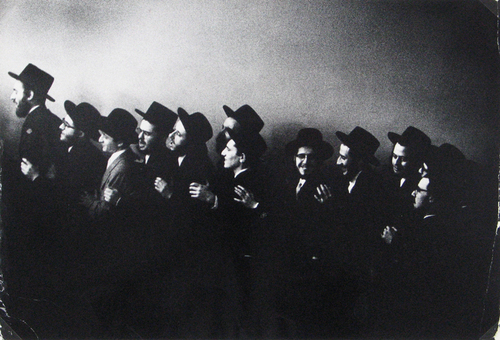
Leonard Freed, Wedding Dance, Williamsburg, New York, 1954 (via MoMA)

-

"So it follows that all that is here is not to be despised and put down, but, precisely because it did precede us, to be taken by us with the innermost understanding that these appearances and things must be seen and transformed."

— Rainer Maria Rilke, from a letter to Witold Hulewicz, 13 November 1925 (via)

"So the photographs are the punctuation points in my work process. But I do see them as dysfunctional narratives. They look like they’re beginning to tell a story; you try to make associations between the people and what they’re doing but you can’t necessarily find a narrative... I want you, the viewer, to be following a natural progression, a natural course of events. By having the camera as a witness—I’m not tampering."

— from an interview with Sam Taylor-Wood in BOMB

-

Next month, New Directions will publish a collection of William Carlos Williams’s translations of Spanish and Latin American Poets.  By Word of Mouth: Poems from the Spanish 1916–1959 has been compiled and edited by translator and Williams’ scholar Jonathan Cohen. Included in this bilingual edition are the giants—Neruda, Paz, and Parra—as well as many lesser-known poets such as Alfonso Guillén Zelaya and Alí Chumacero. (via)

-

"In space
                I am
inside of me
                    the space
outside of me
                       the space
nowhere
               I am
outside of me
                      in space
inside
           is space
outside of it
                    nowhere
I am
         in space
etcetera"

— Octavio Paz, "Reversible" in The Collected Poems
-

Harry Callahan, At the Water's Edge, 1972, Cape Cod (via)

-

"I'm beginning to know myself. I don't exist.
I'm the space between what I'd like to be and what others made of me.
Or half that space, because there's life there too...
So that's what I finally am...
Turn off the light, close the door, stop shuffling your slippers out there in the hall.
Just let me be at ease and all by myself in my room.
It's a cheap world."

— Fernando Pessoa, "[I'm beginning to know myself]" in Poems, trans. Edwin Honig and Susan M. Brown


"You have to remember this isn't your land.
It belongs to no one, like the sea you once lived beside
and thought was yours. Remember the small boats
that bobbed out as the waves rode in, and the men
who carved a living from it only to find themselves
carved down to nothing. Now you say this is home,
so go ahead, worship the mountains as they dissolve in dust,
wait on the wind, catch a scent of salt, call it our life."

— Philip Levine, from "Our Valley"

-

"As for Keats, I think he inherited an aesthetic that only allowed him to write about lovely things. Whereas Lorca inherited an aesthetic that allowed him to write about anything—even what he didn't understand. And that was one of the wonderful things that I got from him, and later got from Pablo Neruda—the idea that you could go after these very powerful centers of feeling in you, even if you couldn't parse them."

— Philip Levine, from a 1999 interview in The Atlantic

"I want to know the root goes deep
on all that came before,
you could lay a soaker hose across
your whole life and know
there was something
under layers of packed summer earth
and dry blown grass
to moisten."

— Naomi Shihab Nye, from "Last August Hours Before the Year 2000"

-

Egon Schiele, Street in Krumau, 1917

-

"Women and couples in Klimt's erotic drawings swim in their own sexuality and at the same time swim away from themselves in line and contour. They unveil their sensuousness. Schiele's erotic figures don't unveil, they expose themselves, angular and strung-out, like guilty things caught. Certain poems unveil themselves with an almost ceremonial patterning, while others are spiky and nervous, as if words were rudely taken hostage to feeling. Plath's are like that, and many of Williams's early poems. Then there are poems, the precious few, that seem long-prepared, arranged just so, with a deliberate rhetoric, but nothing in them feels inauthentic or worked up for the sake of writing a poem. Then there are others, the proliferating many, prepped and constructed for quick and easy consumption. Of these we remember none of the words, nothing of the noise or music, only the scene, or anecdote, or 'voice.'"

— W. S. Di Piero, from "Semba!: A Notebook"

-

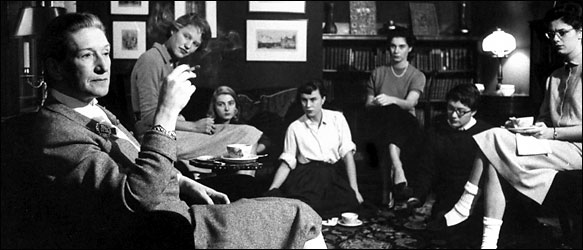
Elizabeth Bowen with students at Bryn Mawr, 1956. Photographed by Alfred Eisenstaedt

"If Bowen is not read now as widely as Henry James and Virginia Woolf, to whom she is often compared, it may be not because of her hyphen (since the specific concerns of the Anglo-Irish are not so widely understood these days), or the intricacy of her style. It may be, instead, that it is difficult to read a writer who bears down so hard on intimacy—among not only men and women, but men and women and their country, their houses, their pasts and themselves—and with an overwhelming, Irish sense of a bottomless, ancient pool of loss. She is as ruthless as James, as stylistically uncanny as Woolf, but with an ineradicable sense that history is made of other people's dirt. In photos, Bowen is impeccably ladylike, with a long upper-class face. But in her work, she's not reserved and her concerns do not seem quaint; she ventures unbearably close to ruins and wreckage, offering as consolation only an aesthetics of the haunted."

— Stacey D'Erasmo, from "Elizabeth Bowen: A Fan's Notes"

"'There’s a strange thing about love,' said Sophia. 'The more you love someone the less that person likes you.' 'That’s very true,' commented the grandmother. "And then what do you do?' 'You keep loving,' answered Sophia threateningly. ‘You love more and more terribly.'"

— Tove Jansson, The Summer Book (via NYRB)

-

Pablo Valbuena, part of his Augmented Space project (see more here)

-

"I don't love you as if you were a rose of salt, topaz,
or an arrow of carnations that propagate fire:
I love you as one loves certain dark things,
secretly, between the shadow and the soul.

I love you as the plant that doesn't bloom and carries
the light of those flowers, hidden, within itself,
and thanks to your love the tight aroma that rose
from the earth lives in my body in darkness.

I love you without knowing how, or when, or from where
I love you directly without problems or pride:
I love you like this because I don't know any other way to love

except in this form in which I am not nor are you,
so close that your hand upon my chest is mine,
so close that your eyes close with my dreams."

— Pablo Neruda, "Sonnett XVII" in The Poetry of Pablo Neruda, trans. Mark Eisner

-

"Tichý the man was equally disheveled. A ragged town eccentric, he had been trained as a classical painter but quit the academy after the Communist takeover forced artists to focus on socialist subjects. He remained, however, a diligent practitioner of the arts. He took three rolls of film a day, printed each negative only once, and embellished the prints with homemade frames. The results amount to a clever commentary on the state; his disguised cameras and the atmosphere of surveillance in his work subtly allude to the surveillance of the society at large. But the furtive pictures are also beautiful. They recall the scratched bodies of Degas’s bathers; they presage the soft focus of Richter. Their imperfection imprints them with the personal. As Tichý himself said, 'A mistake. That’s what makes the poetry.'"

-- from The Paris Review's portfolio and profile of Miroslav Tichý's work

-

Miroslav Tichý

-

"That's the way it goes. For many weeks you have been exploring what seemed to be a profitable way of doing. You discovered that there was a fork in the road, so first you followed what seemed to be the less promising, or at any rate the more obvious, of the two branches until you felt that you had a good idea of where it led. Then you returned to investigate the more tangled way, and for a time its intricacies seemed to promise a more complex and therefore a more practical goal for you, one that could be picked up in any number of ways so that all its faces or applications could be thoroughly scrutinized. And in so doing you began to realize that the two branches were joined together again, farther ahead; that this place of joining was indeed the end, and that it was the very place you set out from, whose intolerable mixture of reality and fantasy had started you on the road which has now come full circle. It has been an absorbing puzzle."

— John Ashbery, from Three Poems (via The Muse Daily)

-

"I have the feeling that his hands ache, that he is tender
and absorbed in thoughts, he licks everything before killing it,
he bursts into tears, scraping meat, he is blessed
he has no friends, he is walking alone in the world

I have the feeling he is saying something to me
that he is watching me with regret
he knows I could never sleep with him
we are both humiliated"

— Tomas Salamun, from "To Have a Friend," trans. Anselm Hollo

-

Frank O'Hara and John Ashbery (via)

"On some shelf in some hexagon, it was argued, there must exist a book that is the cipher and perfect compendium of all other books, and some librarian must have examined that book; this librarian is analogous to a god. In the language of this zone there are still vestiges of the sect that worshipped that distant librarian. Many have gone in search of Him. For a hundred years, men beat every possible path—and every path in vain. How was one to locate the idolized secret hexagon that sheltered Him? Someone proposed searching by regression: To locate book A, first consult book B, which tells where book A can be found; to locate book B, first consult book C, and so on, to infinity..."

— Jorge Luis Borges, from "The Library of Babel," in Collected Fictions, trans. Andrew Hurley

-

Colorado National Bank Blueprints, Dome and Skylight, 15 January 1914 (via)

-

"You will follow the book, whose every page is an abyss where the wing shines with the name."

— Edmond Jabès, from From the Book to the Book, trans. Rosmarie Waldrop

-

"There is no Frigate like a Book
To take us Lands away
Nor any Coursers like a Page
Of prancing Poetry—
This Traverse may the poorest take
Without oppress of Toll—
How frugal is the Chariot
That bears the Human Soul—"

— Emily Dickinson, "[There is no Frigate like a Book]"

-

Yue Minjun, Maze Painting Series (via)

"Sure of itself, the stone claims nothing, whereas the tree, that mute entreaty, and the animal, an agonizing appeal, torment themselves this side of speech. Ages of silence and of screams wait in vain for us to deliver them, to serve as their interpreters; deserters of the world, we no longer aspire to anything but the reign of the undifferentiated, the darkness and the drunkenness of an epoch before daybreak, the uninterrupted ecstasy at the heat of that original opacity whose traces, now and then, we rediscover deep in ourselves or on the periphery of God."

— E. M. Cioran, The Temptation to Exist, trans. Richard Howard

-

Giovanni Bellini's circle, A Man in a Turban (via)

-

"A poem should be equal to:
Not true.

For all the history of grief
An empty doorway and a maple leaf.

For love
The leaning grasses and two lights above the sea—

A poem should not mean
But be."

— Archibald MacLeish, from "Ars Poetica"

-

Bill Brandt, Self-Portrait with Mirror, East Sussex Coast, 1966 (via)

-

"There is too much self in my writing. Do you know the term Lukács uses to describe aesthetic structure? Eine fensterlose Monade. I do not want to be a windowless monad—my training and trainers opposed subjectivity strongly, I have struggled since the beginning to drive my thought out into the landscape of science and fact where other people converse logically and exchange judgments—but I go blind out there. So writing involves some dashing back and forth between that darkening landscape where facticity is strewn and a windowless room cleared of everything I do not know. It is the clearing that takes time. It is the clearing that is a mystery."

— Anne Carson, Economy of the Unlost

"It is—in the latter half at least—a phallic novel, but tender and delicate. You know I believe in the phallic reality, and the phallic consciousness: as distinct from our irritable cerebral consciousness of today. That's why I do the book—and it's not just sex. Sex alas is one of the worst phenomena of today: all cerebral reaction, the whole thing worked from mental processes and itch, and not a bit of the real phallic insouciance and spontaneity. But in my novel there is."

— D. H. Lawrence, writing about Lady Chatterley's Lover, 15 March 1928

-

Lucian Freud, Naked Man on a Bed, 1987

-

"At such moments I feel mad to do it in some filthy way, to feel your hot lecherous lips sucking away at me, to fuck between your two rosy-tipped bubbies, to come on your face and squirt it over your hot cheeks and eyes, to stick it between the cheeks of your rump and bugger you.

Basta per stasera!

I hope you got my telegram and understood it.

Goodbye, my darling whom I am trying to degrade and deprave. How on God's earth can you possibly love a thing like me?"

— James Joyce, from a letter to Nora Barnacle, 6 December 1909 (via)

-

Lucian Freud, etching of Naked Man on a Bed, 1987

-

"You know ... I shall not be fashionable long. They will find me out. ... I like such awfully unfashionable things—and people... you see I am not a high-brow. Sunday lunches and very intricate conversations on Sex and that 'fatigue' which is so essential and that awful 'brightness' which is even more essential—these things I flee from."

— Katherine Mansfield, from a letter to William Gerhardi, 1921

"You're like a witness. You're the one who goes to the museum and looks at the paintings. I mean the paintings are there and you're in the museum too, near and far away at the same time. I'm a painting. Rocamadour is a painting. Etienne is a painting, this room is a painting. You think that you're in the room but you're not. You're looking at the room, you're not in the room."

— Julio Cortázar (via)

-

Beata Bieniak (via)

-

"I am kneeling before the white wall
I write my name
upon the water. I see the hours
passing like clouds. There is no
bottom. Neither abyss.
At my feet shadow draws back.
Who am I? Do you not know me?"

— Ernesto Mejía Sánchez, from "Vigils," trans. William Carlos Williams (via wood s lot)"

-

Ingmar Bergman, Through a Glass Darkly, 1961

-

"This very second has vanished forever, lost in the anonymous mass of the irrevocable. It will never return."

— E. M. Cioran (via)

-

"Stay with us one more Birthday, Ned —
'Yesterday, Today, and Forever,' then we will let you go."

— Emily Dickinson, from a letter to her nephew, Ned, 19 June 1883

-

Marc Chagall, Birthday, 1915 (via)

-

"My birthday began with the water —
Birds and the birds of the winged trees flying my name
      Above the farms and the white horses
                  And I rose
            In rainy autumn
And walked abroad in a shower of all my days."

— Dylan Thomas, from "Poem in October"

-

John Singer Sargent, The Birthday (Fête Familiale), 1887 (via)

-

"... on my birthday we walked among the downs, like the folded wings of grey birds; and saw first one fox, very long with his brush stretched; then a second; which had been barking, for the sun was hot over us; it leapt lightly over a fence and entered the furze — a very rare sight. How many foxes are there in England?"

— Virginia Woolf, from a diary entry dated 26 January 1930

"The walls recede, the roof vanishes, and you float quite naturally
You float uprooted, dragged off, lifted high
You are transported, immortalized, saved, honored
Thanks to that subtle, continuous rhythm…"

— Reinaldo Arenas, from "The Parade Ends"

-

Corin Redgrave applies his makeup backstage at the Lyric theatre, where he appeared as Duke Ferdinand in a musical adaptation of Shakespeare's Love's Labours Lost, 1959 (via)

-

"It would be... heartless terror. Yes. Terrible, and...

Very great. To shed your skin, every old skin, one by one and then walk away, unencumbered, into the morning."

— Tony Kushner, from Angels in America

-

Jean-Baptiste-Camille Corot, Landscape by the Lake, c. 1865-70 (via)

-

"In the valleys, where the song
of the weary farmer sounds,
and when I sit and mourn
the illusions of youth fading,
and on the hills where I recall
and grieve for my lost desires
and my life's lost hope, I think of you
and start to shake."

— Giacomo Leopardi, from "To His Lady," trans. Jonathan Galassi

Paul Klee, Angelus Novus, 1920

-

"A Klee painting named Angelus Novus shows an angel looking as though he is about to move away from something he is fixedly contemplating. His eyes are staring, his mouth is open, his wings are spread. This is how one pictures the angel of history. His face is turned toward the past. Where we perceive a chain of events, he sees one single catastrophe which keeps piling wreckage and hurls it in front of his feet. The angel would like to stay, awaken the dead, and make whole what has been smashed. But a storm is blowing in from Paradise; it has got caught in his wings with such a violence that the angel can no longer close them. The storm irresistibly propels him into the future to which his back is turned, while the pile of debris before him grows skyward. This storm is what we call progress."

— Walter Benjamin, "Theses on the Philosophy of History," 1940

"I told you before, that I had taken another turn at the Schiller Correspondence. The two Letters, numbered 389 and 390, have set me thinking again. Schiller says, 'Can it really be, that Tragedy does not suit your nature, because of its pathetic force?' And again, 'A certain reckoning on the spectators is a hindrance to you, and perhaps for that very reason, you are the less fitted to be a writer of Tragedy, because you are altogether created for a poet in the highest sense. Anyhow, I find in you all the poetic specialities of the writer of Tragedy, in their fullest measure, and if, notwithstanding this, you are really unable to write a perfectly genuine tragedy, the reason must lie in the non-poetical requisites.'

I, for my part, do not understand this chiaroscuro, and much I know about writing a Tragedy, or whether such things let themselves be written; when poetry bears about the same relation to the writing, as music does to the notes. It becomes clearer to my mind, when I remember, that Schiller was just then wrestling hard with his Wallenstein, and trying, as it were, to hook poetry to it."

— Johann Wolfgang von Goethe, from a letter to Carl Friedrich Zelter, 27 October 1831

-


Lines from a poem by Goethe, signed and dated 1 March 1826 (via)

-

"Few critics have even admitted that Hamlet the play is the primary problem, and Hamlet the character only secondary. And Hamlet the character has had an especial temptation for that most dangerous type of critic: the critic with a mind which is naturally of the creative order, but which through some weakness in creative power exercises itself in criticism instead. These minds often find in Hamlet a vicarious existence for their own artistic realization. Such a mind had Goethe, who made of Hamlet a Werther; and such had Coleridge, who made of Hamlet a Coleridge; and probably neither of these men in writing about Hamlet remembered that his first business was to study a work of art. The kind of criticism that Goethe and Coleridge produced, in writing of Hamlet, is the most misleading kind possible. For they both possessed unquestionable critical insight, and both make their critical aberrations the more plausible by the substitution—of their own Hamlet for Shakespeare's—which their creative gift effects. We should be thankful that Walter Pater did not fix his attention on this play."

— T. S. Eliot, from "Hamlet," 1920

-


First edition of Goethe's Die Leiden des jungen Werthers (The Sorrows of Young Werther), 1774 (via)

-

"After the seventeenth century, few English authors were able to write verse plays comparable to those of Shakespeare and Webster (though almost every major Romantic tried his hand at them), but poets in other languages, such as Goethe and Pushkin, were able to follow that tradition. Perhaps English-speaking authors felt overwhelmed by Shakespeare, but other poets were able to pick up on the tradition and continue it, thereby expanding their own literatures. What can we learn from literatures of other languages in the same way that Pushkin and Goethe learned from Shakespeare?"

— Ilya Kaminsky, from "Various Tongues," an exchange with Adam Kirsch

"I am ashamed of the violence of my own love.
In this ruined house how I had hoped to be a builder!

Today our verses, Asad, are only an idle pastime.
What's the use of flaunting our talent, then?"

— Mirza Asadullah Khan Ghalib, from "Twilight in Delhi," trans. R. Parthasarathy

-

"Among the shadows of people, sea horse bodies dry,
Lose translucence, become rough and blunt.

Between two fingers you crush them, beauty and love,
Into what is not beautiful and what (you don’t remember) stopped loving."

— Aleš Šteger, from "Sea Horse"


A young Marcel Proust at Combray with the famous magic lantern (via)

-

"... at Combray on Sunday mornings one had the delight of emerging upon a festive street, but where that street was paved with water of a sapphire blue, refreshed by little ripples of cooler air, and of so solid a colour that my tired eyes might, in quest of relaxation and without fear of its giving way, rest their gaze upon it."

— Proust, Albertine disparue, 1925, trans. C. K. Moncrieff and Robert Kilmartin

-
Proust at the Club des Découvreurs (via)

-

"I am finishing a book which in spite of its provisional title: Contre Sainte-Beuve, souvenir d'une matinée, is a genuine novel and an extremely indecent one in places. One of the principal characters is a homosexual. And this I count on you to keep strictly secret. If the fact were known before the book appeared a number of devoted and apprehensive friends would ask me to abandon it. Moreover I fancy it contains some new things (forgive me!) and I shouldn't like to be robbed by others. The name of Sainte-Beuve is not there by chance. The book does indeed end with a long conversation about Sainte-Beuve and about aesthetics (if you like, as Sylvie ends with a study of a popular song) and once people have finished the book they will see (I hope) that the whole novel is simply the implementation of the artistic principles expressed in this final part, a sort of preface if you like, placed at the end."

— Proust writing to publisher Alfred Vallette as A la recherche du temps perdu was emerging from his earlier piece, Contre Sainte-Beuve, August 1909. As quoted in William C. Carter's Marcel Proust: A Life.

"I'd read to him at night. His horoscope,
The New York Times, The Advocate;
Some lines by Richard Howard gave us hope.
A quiet hospital is infinite,
The polished, ice-white floors, the darkened halls
That lead to almost anywhere, to death
Or ghostly, lighted Coke machines.  I call
To him one night, at home, asleep.  His breath,
I dreamed, had filled my lungs--his lips, my lips
Had touched.  I felt as though I'd touched a shrine.
Not disrespectfully, but in some lapse
Of concentration.  In a mirror shines


The distant moon."

— Rafael Campo, from "The Distant Moon"

-

Nan Goldin

-

"Nothing is more punitive than to give a disease a meaning... The disease itself becomes a metaphor. Then, in the name of the disease (that is, using it as a metaphor), that horror is imposed on other things. The disease becomes adjectival."

— Susan Sontag, Illness as Metaphor, 1978


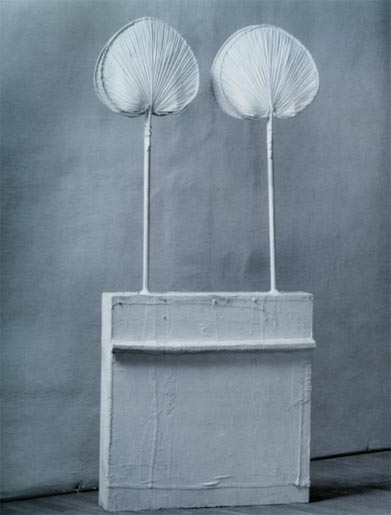
Cy Twombly, Untitled (Funerary Box for a Lime Green Python), 1954

-

"The at-once-ness of literal and allusive white paint, addressed above, now meets the seemingly contradictory, or at least discrete, quality of in-between-ness, registered in this case as what lies between the sculpture’s literal materials and its allusive title. Even so, here we must recall that the larger part of Twombly's title functions as a parenthetical, after that initial laconic Untitled. Parentheses are used to bracket an insertion without which a sentence, or a meaning, would yet remain grammatically correct. Or, more loosely, to bracket a digression, an interlude — better still, an interval. This title's parentheses point to the literal, grammatical fact of the gap as well as to the idea of the gap, the idea of the space-between."

— Kate Nesin, from "Some Notes on Words and Things in Cy Twombly's Sculptural Practice"

-


Cy Twombly, Petals of Fire, 1989

-

"I'm a painter and my whole balance is not having to think about things. So all I think about is painting. It's the instinct for the placement where all that happens. I don't have to think about it. So I don't think of composition; I don't think of colour here and there. Sometimes I alter something after. So all I could think is the rush. This is in certain things and even up to now, like The Four Seasons, those are pretty emotionally done paintings. And I have a hard time now because I can get mentally ill. I usually have to go to bed for a couple of days. Physically I can't handle it, and I can't build myself. You know, my mind goes blank. It's totally blank. I cannot sit and make an image. I cannot make a picture unless everything is working. It's like a state."

— Cy Twombly, from a 2001 interview with David Sylvester

"[Cocteau's] early years are dominated by the ballet; then comes the theater, and also fiction; and finally films: that is to say, predominantly the visual media, conjuring up spectacles. As noted before, he classified all these activities as poetry: (just plain) poésie, poésie de théâtre, poésie du roman, poésie cinématographique, even poésie critique.

So he was primarily a poet of the spectacle: the circus, the parade. He is like a harlequin leading the parade in Fellini's Clowns. One of his finest contributions to the 'idea' of the theater in the twentieth century was the distinction, articulated in 1921 in his preface to the ballet scenario for Les mariés de la Tour Eiffel, between 'poésie de théâtre' [theater poetry] and 'la poésie du théâtre' [poetry in the theatre]. With this formula he entered the lists of the advocates of a new kind of theater-poetry, in contrast to the verse-theater favored by T. S. Eliot or Christopher Fry, some fifteen to twenty years later."

— Walter A. Strauss, from "Jean Cocteau: The Difficulties of Being Orpheus," in Reviewing Orpheus: Essays on the Cinema and Art of Jean Cocteau, edited by Cornelia A. Tsakiridou

-


Portrait of Jean Cocteau by André Papillon, 1939 (via)

-

"Le fond de la mer a ses saisons. Comme sur la terre, le printemps est une des plus belles. Le corail bourgeonne et les éponges respirent l'eau bleue à pleins poumons. Une forêt de cerfs rouges écoute un bruit d’hélice. Il arrive de très haut dans les cieux de la mer. Il tombe lentement et se roule dans le sable. Les fleurs dorment debout et il y en a une foule qui diesent adieu. Les poissons manchots se posent dessus. Ils donnent de gros baisers à la mer. A cause de l'éclairage et du décor on se croirait souvent chez le photographe. Un panache de globules gazouille dans le coin. Il s'échappe du petit robinet qui change l'eau salée."

— Cocteau, "Le Printemps au fond de la mer," in Poésies

"It is twenty-five years since the Hogarth Press launched its edition of Woolf’s essays. Stuart N. Clarke, who took over the editorship from Andrew McNeillie after Volume Four, now completes the series with essays published between 1933 and 1941."

— Trev Broughton, from "Virginia Woolf's Late Essays" in The Times Literary Supplement

-


Marianne Brandt, Ashtray, 1924 (via MoMA; see the website for their exhibition on German Expressionism)

-

"No one wants to reopen the wounds; no one wants to stick           the gored. We can call this a new 'happy problem.'

                                                            'The only way,'

says I; says the old I; says the unmanhandled I and I recall this could be a tasty thing. Let me draw my neck out—just so to see.
                                                                            I want to see how willing the 'I' is. Just to see how willing 'I' am. How willing 'I' should be.

And, yes, yes, someone said yes, someone said yes to me. I was unsafe and I was safe and I was oh so ready."

— Leah Umansky, from "Life is a Verb" (via BOMBlog)

-


"How many books will Alan Hollinghurst have to write before the press stops asking him about his sexuality? When will the beauty of his words simply be enough?"

— Elizabeth Minkel in The New Yorker on Alan Hollinghurst's writing and his forthcoming book, The Stranger's Child

-

"Nabokov treated fame as if it were a novel to be read or written according to the details. ... So it comes as no surprise that Nabokov staged a photo for Life Magazine in 1959 in which he is seen writing Lolita on notecards in the Nabokov family sedan, after the novel had been published. Or that he gladly appeared on the cover of Time in 1969 and Newsweek in 1962. Or that he corrected Carl Proffer’s Keys to Lolita and revised Andrew Field’s biography of him, saying that his life resembled 'a bibliography rather than a biography' and that the best part of a writer's biography is not 'the record of his adventures but the story of his style.' Or that he tightly controlled the collection of his short stories, compiling them according to 'theme, period, atmosphere, uniformity, variety.' Or that he translated his early Russian novels, such as Bend Sinister, Despair, and The Luzhin Defense, as well as the autobiography that became known as Speak, Memory, into English himself, making substantial revisions and adding prefaces to the texts. Or that he conducted and wrote all of his interviews himself."

— Sarah Fay, from "Vladimir Nabokov and the Art of the Self-Interview" at The Paris Review